

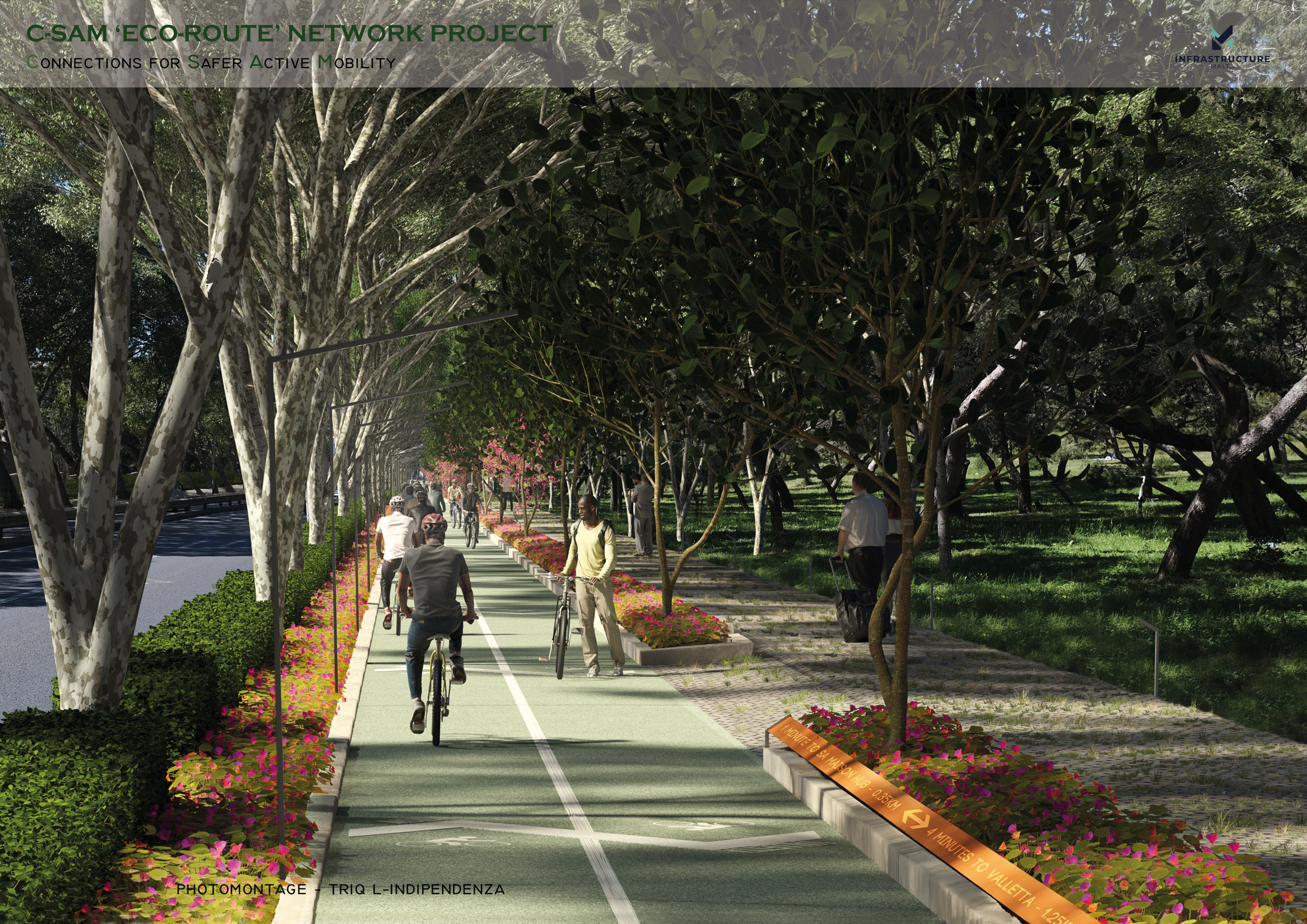
Infrastructure Malta Unveils the Connections for Safer Active Mobility Project
Infrastructure Malta has launched the Connections for Safer Active Mobility Project, a strategic initiative aimed at strengthening connections for those who choose to travel on foot or by bicycle. At its core, the project aims to make active modes of transportation not only possible but also practical, safe, and inviting.
The vision extends beyond connecting places. It aims to link modes of travel, integrating walking and cycling routes with public transport nodes and future mobility hubs. In doing so, the project aspires to create a seamless network where shifting from private vehicles to alternative modes becomes a natural and efficient choice.
Routes will be designed to be direct, continuous, and tailored to the needs of their users. Careful attention will be given to safety and appropriateness of infrastructure, while prioritising connections between green spaces, town centres, and busy urban nodes. The objective is clear: to elevate the everyday experience of walking and cycling into one that is efficient, comfortable, and enjoyable.
Over the past six years, Infrastructure Malta has delivered several kilometres of cycling lanes and pedestrian connections as part of broader infrastructure projects. This new initiative builds on that foundation, bringing active mobility into sharper focus through a coherent, interconnected network that supports meaningful modal shift.
The identified routes serve different functions. Transit corridors will provide direct links between towns and regions, while local connections will lead into the heart of villages and urban centres.
Initial implementation will prioritise the Sustainable Urban Mobility Plan (SUMP) area, encompassing the Northern and Southern regions of the Grand Harbour.
Phase 1 focuses on a central 3km corridor connecting Sa Maison, Valletta, the Sea Passenger Terminal, and Blata l-Bajda. This route will link strategic nodes, including Valletta, the periphery of Hamrun, the Sea passenger Terminal, and four major public transport interchanges, creating vital north-south connectivity across the Grand Harbour area.
The planned alignment will extend from the Blata l-Bajda bridge along St Joseph High Street, towards St Joseph School in San Gorg Preca Street, continuing to Independence Avenue alongside the Floriana Pinetum gardens, and onwards to Marina Road and Sa Maison. Connections will also reach the Sea Passenger Terminal at Xatt l-Ghassara tal-Gheneb in Marsa and the area near Porte Des Bombes in Triq Nazzjonali.
The project also envisages the provision of 3 pedestrian bridges, one along the Pinetum garden area in Floriana, and two pedestrian bridges along Triq Dicembru Tlettax in Marsa.
Infrastructure Malta is currently working on the finalisation of the Phase 2 route which will extend safe active mobility infrastructure to Paola.
This project is co-financed by the European Union’s Cohesion Fund 2021-2027.